FlowForge
AI-powered workflow elicitation platform — 🏆 3rd Place
Tech Stack
Overview
FlowForge is an AI-powered platform that closes the gap between informal business requirements and formal digital execution. It uses a multi-agent AI pipeline to turn unstructured business knowledge into structured, executable workflows. The system is split into three layers: a React 19 + TanStack Start frontend with a ReactFlow canvas for visualizing generated workflows, a NestJS backend gateway handling business logic and orchestration, and a Python AI service running the elicitation pipeline — all built around a "Zero Waste" token philosophy for delivering professional-grade workflow extraction on resource-constrained hardware. The main goal is to reduce the mechanical cost of producing executable workflow definitions while keeping the entire stack on-premise and allowing users to iterate with live feedback.
The Story
Background
ETIC club organized a hackathon hosted at ESI. I gathered my team (shoutout to them 🙌) and we registered. Competition was intense. The problem we chose to solve: how to help companies organize their internal workflows so they're coherent and understandable for everyone — instead of scattered across roles — while keeping work collaborative and communication transparent.
Key Achievements
- Architected the ReactFlow canvas that renders AI-generated workflows in real time
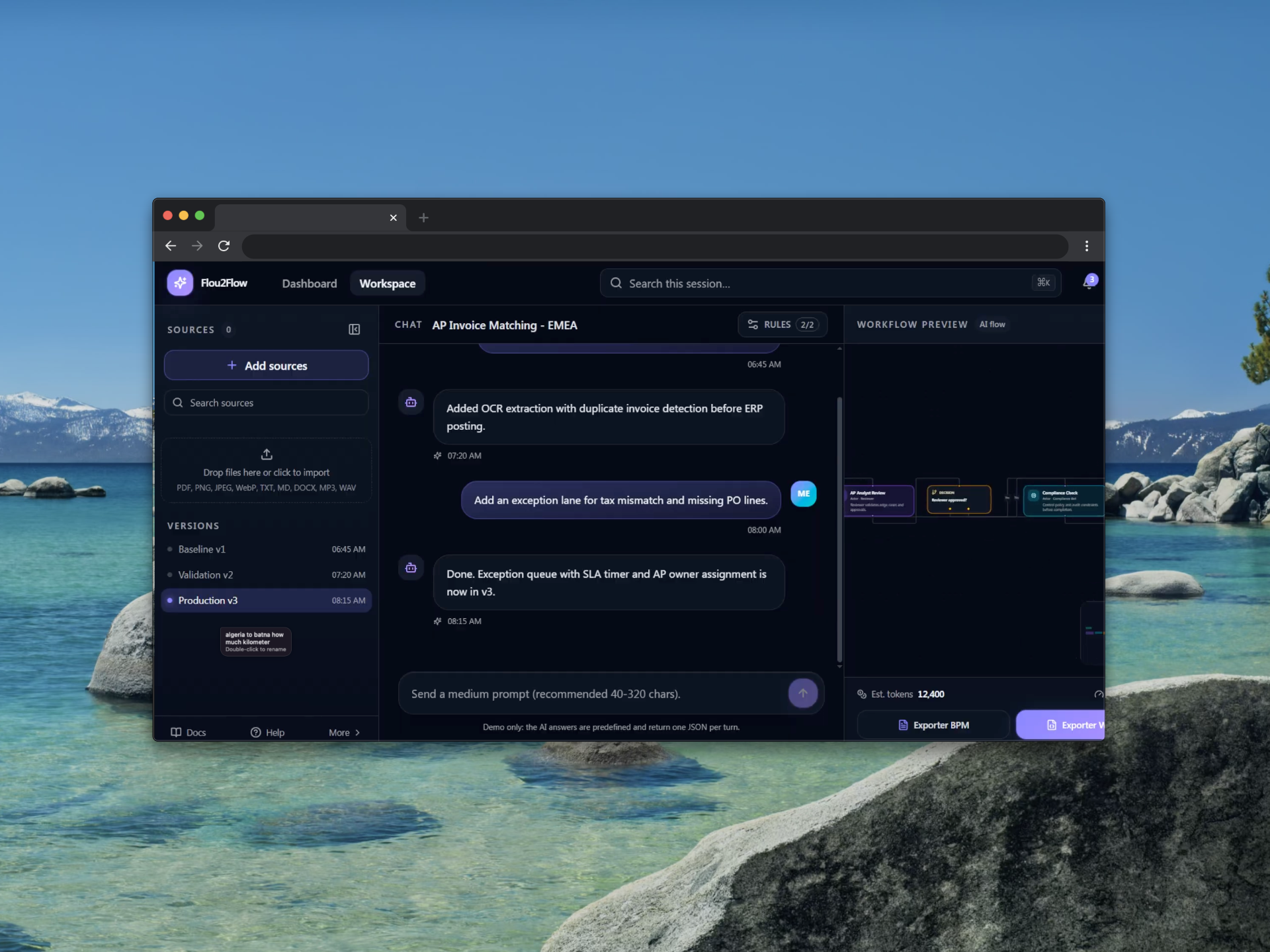
- Built the session-scoped workspace (chat, sources panel, live workflow preview)
- Connected the frontend to the NestJS gateway via a typed API client and NATS-driven realtime updates
- Contributed to the heterogeneous model routing strategy — Ollama models picked per task (Mistral 7B reasoning, Qwen2/SmolLM for lightweight steps, LLaVA for vision, Whisper for voice) to hit the "Zero Waste" token budget
- Shipped a working multi-agent pipeline under hackathon time constraints, placing 3rd
Impact
FlowForge gave companies a way to turn scattered, tribal-knowledge processes into a single coherent, visual workflow — closing the transparency gap between departments — which is what earned the team 3rd place.